


Today, Judge Breyer granted Governor Newsom’s motion for a preliminary injunction blocking the president from deploying the California National Guard, and returning control of the Guard to the governor.
Donald Trump’s Department of Justice claims that the president can deploy the National Guard - without review from the courts - under Title 10 U.S.C. § 12406 which says whenever;
(1) the United States, or any of the Commonwealths or possessions, is invaded or is in danger of invasion by a foreign nation;
(2) there is a rebellion or danger of a rebellion against the authority of the Government of the United States; or
(3) the President is unable with the regular forces to execute the laws of the United States;
the President may call into Federal service members and units of the National Guard of any State in such numbers as he considers necessary to repel the invasion, suppress the rebellion, or execute those laws.
First, as to whether the courts can even review Trump’s use of 12406, Judge Breyer writes: Indeed, at the motion hearing, Defendants confirmed their position that, after an initial federalization, all extensions of federalization orders are utterly unreviewable, forever. That is shocking. Adopting Defendants’ interpretation of Section 12406 would permit a president to create a perpetual police force comprised of state troops, so long as they were first federalized lawfully. Such a scenario would validate the Founders’ “widespread fear [of] a national standing Army,” which they believed “posed an intolerable threat to individual liberty and to the sovereignty of the separate States.”
Defendants’ argument for a president to hold unchecked power to control state troops would wholly upend the federalism that is at the heart of our system of government. See Youngstown Sheet & Tube Co. v. Sawyer.
Next, Judge Breyer addresses 12406. He says that the government isn’t really arguing either of the first two preconditions, so he focuses on the third: that “the President is unable with the regular forces to execute the laws of the United States.”
Defendants fail to satisfy two different requirements of that precondition: “is unable” and “regular forces.”
During the hearing on this matter, the government argued that because a guy threw molotov cocktails at one location this past week, that the “regular forces” were “unable” to execute the laws of the United States. I listened to that hearing and Judge Breyer took issue with the government’s position that “unable” means “unable to prevent 100% of crimes.” He drives that point home in his ruling today:
“‘Unable’ requires something much closer to complete incapacity than a two-day minor disruption in a discrete location.”
The government also argued that the “riots” in LA in the past constitute the continuing need to deploy the guard, but as the judge points out, the law doesn’t say “the president WAS unable with regular forces to execute the laws of the United States.” Judge Breyer quotes three other judges in a footnote to address that ridiculous argument:
As Judge Immergut asked, “could the President rely solely on the civil unrest in Portland, Oregon, in 2020, to justify his deployment of military troops to the Portland ICE facility in 2025?” (Judge Bennett: “So if . . . for example, this statute were in effect at the Founding, and President Washington had called up militia to deal with the Whiskey Rebellion, notwithstanding the Whiskey Rebellion having gone away, that they could be called up forever without judicial review.”); (Graber, J., dissenting) (rejecting the government’s suggestion that “even if there is complete calm for weeks beforehand, we should look further back in time to assess whether a present exigency exists.”).
Then we get to the big question: what are “regular forces.” The Supreme Court has asked the parties in the Chicago National Guard case to take a moment and define “regular forces” for them, hinting at the fact that SCOTUS might agree with the plaintiffs in these cases that “regular forces” means the military - and since Trump never deployed the military - this precondition has not been met to deploy the National Guard. The Supreme Court has not yet ruled on the Chicago case, but I’m certain their ruling will inform this case in California, as well as the case in Oregon.
Judge Breyer addresses the “regular forces” question today, and he quotes Marty Lederman’s Amicus Brief on the matter in the Chicago case, which is the authority I used to form my personal opinion on this question:
A review of materials related to the statutory history of Section 12406(3) not before the Court at the time of the TRO persuasively demonstrates that “the regular forces” means the regular forces of the military. As Professor Martin Lederman of Georgetown Law explained, in December of 1901, President Roosevelt “implored Congress to [establish] a means by which the states’ militia could be enhanced and effectively called into service.”
Congress responded to Roosevelt’s appeal by passing the Dick Act in 1903, which among other things sought “to establish closer relations and better cooperation between the National Guard and the Regular Army.” When Congress amended the Dick Act in 1908, it was “to ensure that in cases where the use of the ‘regular forces’ was inadequate to execute federal laws, the President would have to call upon the National Guard as the initial supplement to the standing army before deploying any volunteer units.” Professor Lederman recounted plentiful references to “Regulars” and “the Regular Army” in the congressional reports surrounding the 1903 and 1908 legislation, and in the over-hundred years leading up to it. He concluded that “whenever anyone in one of the three branches discussed ‘the regular forces’ in relation to the militia, the National Guard or the volunteer forces, they were referring to those persons serving within the standing U.S. military, particularly the army.” Indeed, he asserted that he was “unaware of any counterexamples.” Unsurprisingly, when asked at the motion hearing whether there is any historical basis for believing that in 1908, “regular forces” meant anything other than the standing army, Defendants were unable to point to any.
This Court finds this historical review persuasive on the meaning of “the regular forces.” But this Court is also well aware that the Supreme Court will soon rule on this issue, and will have the last word. Accordingly, the Court will apply both the “military” meaning of regular forces and the Court’s earlier understanding of that term.
Even under this Court’s previous understanding of “the regular forces” (civilian law enforcement as opposed to the military,) there is no colorable basis to conclude that civilian law enforcement alone would have had any difficulty enabling the President to execute federal law in August or October.
Judge Breyer concludes:
Defendants are temporarily ENJOINED from deploying members of the California National Guard in Los Angeles.
Defendants are DIRECTED to return control of the California National Guard to Governor Newsom.
The Court STAYS this order until noon on Monday, December 15, 2025.
Plaintiffs are ORDERED to post a nominal bond of $100 within 24 hours. The bond shall be filed in the Clerk’s Office and be deposited into the registry of the Court. If said bond is not posted by the aforementioned date and time, this Order shall be dissolved.
You can read Judge Breyer’s full order granting Newsom’s motion for a preliminary injunction here.
If the Supreme Court does decide that “regular forces” means the military, and that there’s no colorable argument to deploy the National Guard in Illinois regardless, I’m worried Trump and Stephen Miller will turn to the Insurrection Act to continue their assault on American cities. Whatever happens, we’ll cover it here.
~AG
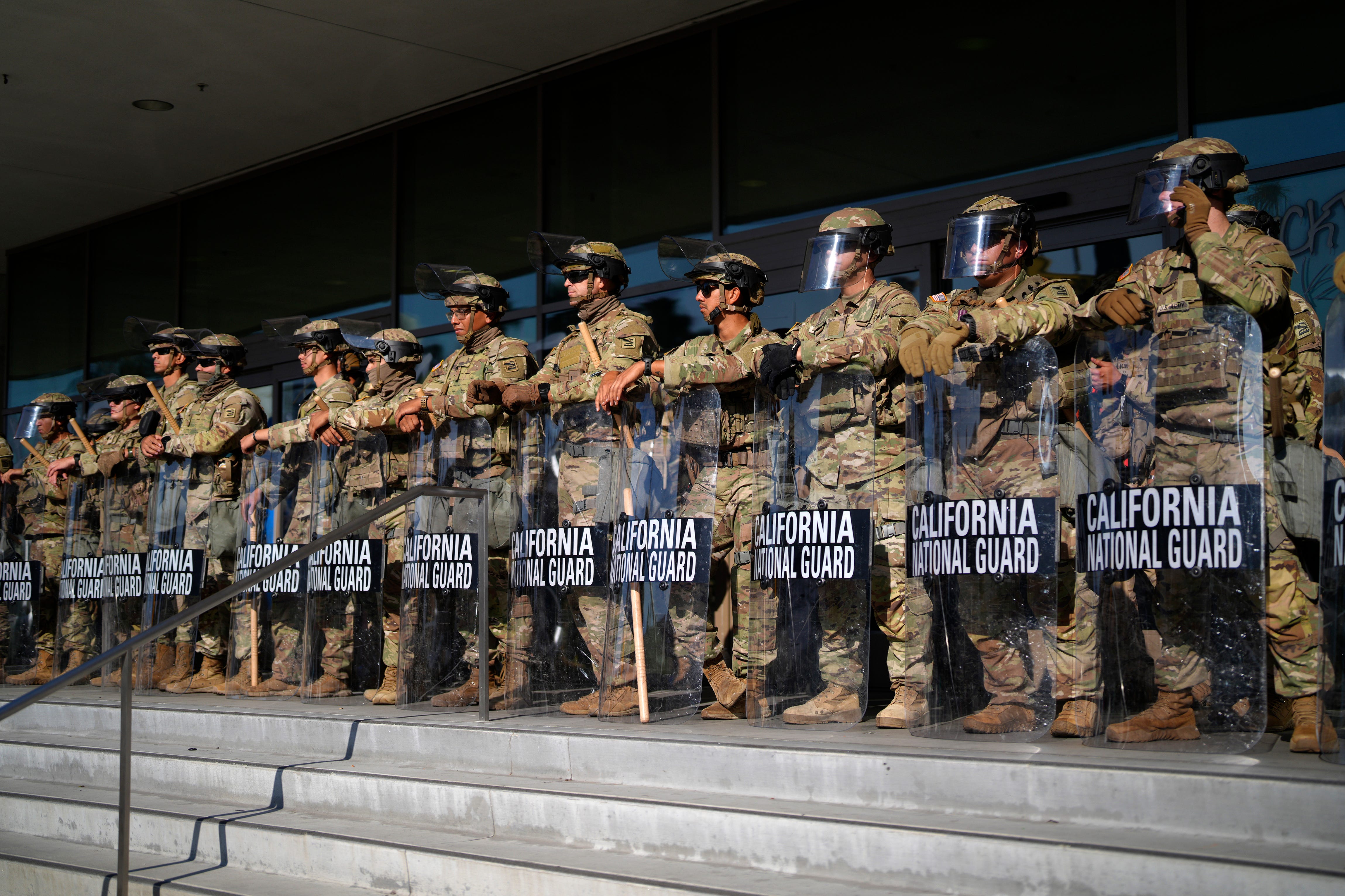
Eric Thayer / AP
Thank you, Allison for this very comprehensive breakdown of Judge Breyer’s decision. We Californians can thank our AG Rob Bonta who is doing extraordinary work.
Finally, a sane and rational interpretation of the statute. The slow-moving coup that this administration is trying to accomplish is meeting some guardrails.