


Tonight, MSW Media (me) and First Amendment Coalition got another favorable ruling in our Freedom of Information Act lawsuit against DOGE. Bottom line up front: the government talked itself into more work, and they still have to get Elon’s private phone number and preserve communications.
BACKGROUND
On February 11th, 2025 MSW Media filed a Freedom of Information Act (FOIA) request to the USDS (DOGE) for “all emails sent or received by employees of the US DOGE Service between February 7th, 2025, and February 10th, 2025, inclusive.” And on February 25th, the First Amendment Coalition filed a similar FOIA request.
By March 28th, we got no response from the government, and filed a lawsuit for declaratory and injunctive relief for a violation of FOIA. In that complaint, we asked the court to find that DOGE is subject to FOIA, and that they must hand over the emails we seek.
Then in April, First Amendment Coalition amended our complaint to include records from Elon Musk’s cell phone(s), as it was widely reported at the time that Musk had offered his mobile number to Sean Duffy during a confrontation, and that he had offered it to multiple Republican Senators during a closed door meeting about DOGE. The amended complaint also asked the court to find DOGE and OMB in violation of FOIA for refusing to accept electronic FOIA requests through FOIA.gov, and require them to do so.
In June, the court transferred our case out of California to the District of Columbia, and the case was assigned to Judge Boasberg. Then in July, FAC filed a motion to preserve possibly responsive records:
Because the Government maintains that USDS is not an agency subject to FOIA and that, even if it is, Musk was not a USDS employee, USDS has not performed a search for responsive records. Because it has not performed a search for responsive records, it has not identified any responsive records. Because it has not identified any responsive records, it has not excluded any responsive records from destruction. This problem is exacerbated because the Government refuses to answer even basic questions about the matter, such as if the cell phone in question is even in Government custody or if it was Musk’s personal cell phone.
In August, Judge Boasberg granted that motion. However, the government only agreed to preserve communications on Musk’s “EOP” phone - Executive Office of the President. They also reiterated their claim that Elon didn’t work for DOGE, but was a special advisor to the president. They simply didn’t acknowledge that Musk may have used a private phone as well. So we filed another motion to compel the government to preserve comms on that phone, too.
DOJ fought this tooth and nail, saying they shouldn’t have to go on a “wild goose chase” to see if Musk gave a private phone number to Sean Duffy and Republican Senators.
After holding a hearing on the matter, Judge Boasberg issued the following minute order on February 3rd:
As discussed in today's hearing, the Court ORDERS that Plaintiff's 48 Motion to Compel is GRANTED to the extent that Defendants shall make a good-faith inquiry of Secretary Duffy and the applicable Senators whether they have a record of or can recall any telephone number(s) that Elon Musk gave to them between January 20 and May 31, 2025. Defendants shall file a Status Report by February 24, 2026, describing such efforts and results.
The government didn’t like that either, and filed a motion to reconsider - meaning they asked to court to change the order because they didn’t think they should have to ask senators for Elon’s phone number because of the speech or debate clause and separation of powers.
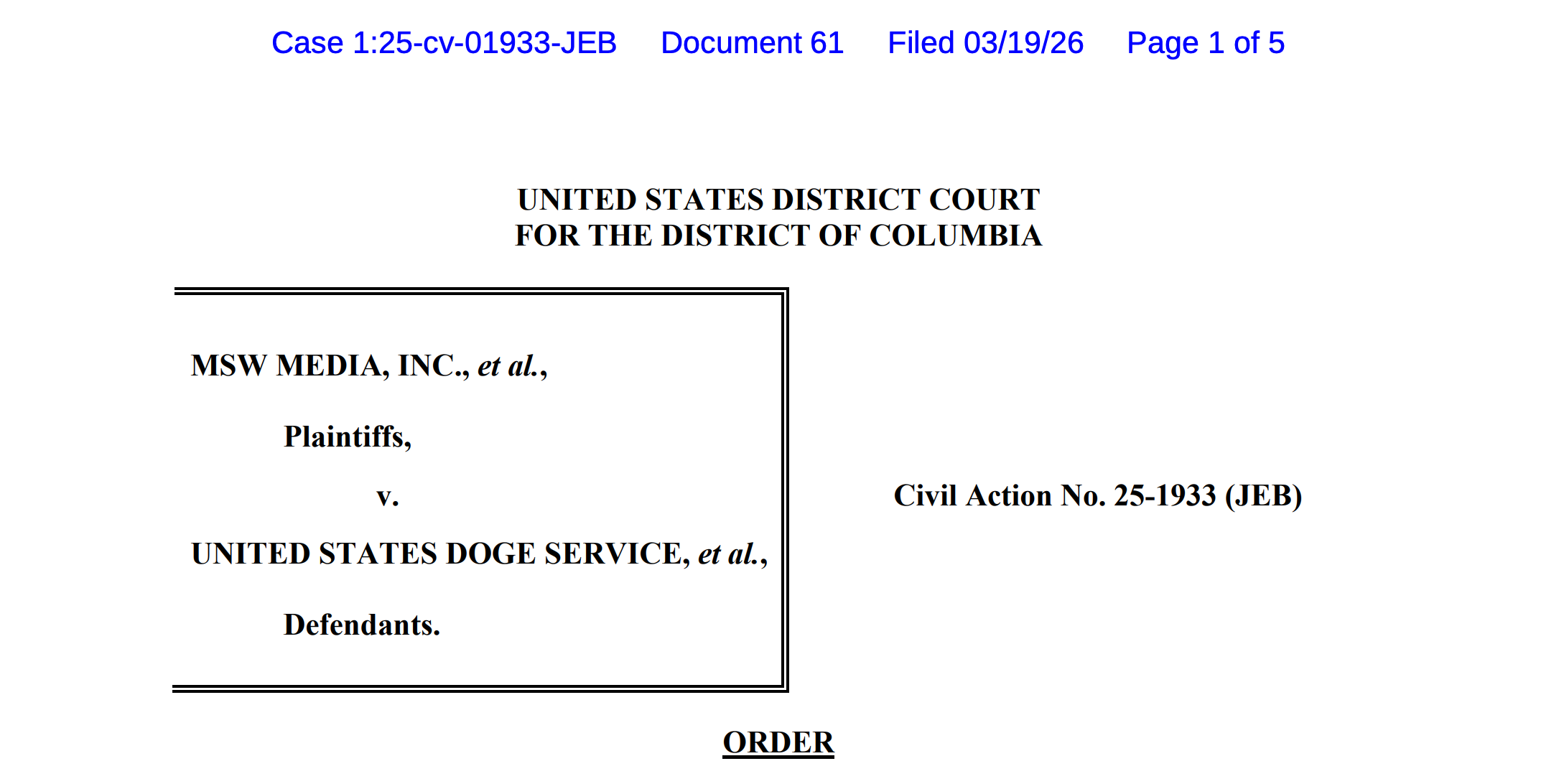
Tonight, Judge Boasberg ruled on their motion to reconsider. He writes:
USDS’s Motion for Reconsideration asserts multiple objections to the Court’s February 3 Order. For example, it protests that requiring it to ask Senators for information amounts to an end run around Congress’s exclusion from FOIA obligations. It also maintains that such a proactive investigation exceeds what FOIA requires the Government to do when faced with a disclosure request.
It is true that Congress is exempt from FOIA’s disclosure obligations, and that agencies have no duty under the statute to acquire new records of which they do not already retain possession or control. But the Court’s Order is not limited by the reach of FOIA. On the contrary, “[f]ederal courts have the inherent power to issue orders preserving information relevant to the claims and defenses brought before them.” United States ex rel. Staggers v. Medtronic, Inc., 2022. The Court has thus tasked USDS with inquiring about Musk’s number so that the relevant records may be identified for preservation. If Musk did conduct government business on a private phone, the related communications would be equally subject to disclosure — and equally critical to preserve — as any records on his government-issued phone. In this sense, the information USDS is asked to acquire serves a purely intermediate function: identifying Musk’s number helps it preserve the records that are the actual subject of Plaintiff’s FOIA request. That single piece of information the Government would obtain — Musk’s number — need not be disclosed to Plaintiff in the end. USDS’s concerns about the applicability and scope of FOIA are thus misplaced; Musk’s number is not the subject of Plaintiff’s FOIA request, and its acquisition is not governed by the bounds of that statute.
While there may be a limit to what actions USDS can reasonably be expected to undertake in service of a preservation order, that limit would come from this Court’s assessment of the good faith of the Government’s efforts, not the contours of FOIA’s disclosure obligations. In any case, the Court finds that USDS’s efforts so far have not come close to that limit. The Government’s worries about a slippery slope of ever-expanding preservation obligations are therefore premature; there will be ample opportunity in future proceedings for the parties and this Court to carefully consider if further preservation measures are needed and what form those measures may take.
USDS additionally raises vague separation-of-powers concerns with ordering the Executive Branch to contact Senators. In doing so, it provides no relevant case, constitutional provision, or even line of reasoning to support its argument, and the Court remains dubious of the merits of such an objection.
Still, the Court will modify its Minute Order to remove the Senator-inquiry mandate, as it believes a different line of investigation may be equally fruitful while avoiding USDS’s concerns. At the hearing and in its briefing, Plaintiff raised the possibility that USDS could instead review its own records to search for any mentions of Musk’s private phone number. (That’s the thing that the government fought tooth and nail against, saying it was too much work.)
Believing that this course of action is both productive and permissible, and in light of the Government’s objection to its first proposal, the Court will order a review of USDS records instead.
Long story short, the government didn’t want to have to ask Senators for Musk’s phone number, so the judge is ordering the government to do what our lawyer suggested at the hearing: to look through DOGEbro’s phones for comms with Elon’s private phone instead.
Defendant United States DOGE Service shall take the following steps to comply with the Court’s Preservation Order: 1) Make a good-faith inquiry of Secretary Duffy whether he has a record of or can recall any telephone number(s) that Elon Musk gave to him between January 20 and May 31, 2025; and 2) Review USDS devices and records to identify any telephone number(s) Elon Musk may have used to communicate with government officials between January 20 and May 31, 2025; and Defendant shall file a Notice by April 3, 2026, informing the Court of its efforts and any accompanying results.
Our lawyer, Kel McClanahan at National Security Counselors explains it like this:
“We asked the government to search their records and figure out what numbers Musk used. They said no. We asked the judge to make them. They said it would be too much work. So the judge compromised and told them they could just ask a bunch of Senators what numbers he gave them. Then the government came back and said “But we don’t want to ask the Senators; please don’t make us.” And they brought their official government-issued monkey’s paw. So now they have to do the work they didn’t want to do because it was too much work all because they couldn’t leave well enough alone. Congrats DOJ; you’re the MVP of the Plaintiffs’ legal team today.”
BUT THAT’S NOT ALL…
Kel continues: “And all the while, they managed to throw a few more sticks on the bonfire that used to be the presumption of regularity. When was the last time you heard a judge say something like “[DOJ] provides no relevant case, constitutional provision, or even line of reasoning to support its argument, and the Court remains dubious of the merits of such an objection?”
You can read the entire 5-page ruling here.
If you want to support our lawyer, who does this work pro-bono, you can make your tax deductible donation to National Security Counselors here.
~AG
Excellent work! Thank you 👏👏👏
Fantastic