


Yesterday, Judge Boasberg held a hearing in the Freedom of Information Act case brought by MSW Media (me) and the First Amendment Coalition against DOGE. Here’s some background to bring you up to speed.
BACKGROUND
On February 11th, 2025 - almost a year ago to the day - MSW Media filed a Freedom of Information Act (FOIA) request to the USDS for “all emails sent or received by employees of the US DOGE Service between February 7th, 2025, and February 10th, 2025, inclusive.” And on February 25th, the First Amendment Coalition filed a similar FOIA request.
By March 28th, we got no response from the government, and filed a lawsuit for declaratory and injunctive relief for a violation of FOIA. In that complaint, we asked the court to find that DOGE is subject to FOIA, and that they must hand over the emails we seek.
Then in April, First Amendment Coalition amended our complaint to include records from Elon Musk’s cell phone(s), as it was widely reported at the time that Musk had offered his mobile number to Sean Duffy during a confrontation, and that he had offered it to multiple Republican Senators during a closed door meeting about DOGE. The amended complaint also asked the court to find DOGE and OMB in violation of FOIA for refusing to accept electronic FOIA requests through FOIA.gov, and require them to do so.
In June, the court transferred our case out of California to the District of Columbia, and the case was assigned to Judge Boasberg. Then in July, FAC filed a motion to preserve possibly responsive records:
Because the Government maintains that USDS is not an agency subject to FOIA and that, even if it is, Musk was not a USDS employee, USDS has not performed a search for responsive records. Because it has not performed a search for responsive records, it has not identified any responsive records. Because it has not identified any responsive records, it has not excluded any responsive records from destruction. This problem is exacerbated because the Government refuses to answer even basic questions about the matter, such as if the cell phone in question is even in Government custody or if it was Musk’s personal cell phone.
In August, Judge Boasberg granted that motion. However, the government only agreed to preserve communications on Musk’s “EOP” phone - Executive Office of the President. They also reiterated their claim that Elon didn’t work for DOGE, but was a special advisor to the president. They simply didn’t acknowledge that Musk may have used a private phone as well. So we filed another motion to compel the government to preserve comms on that phone too.
DOJ fought this tooth and nail, saying they shouldn’t have to go on a “wild goose chase” to see if Musk gave a private phone number to Sean Duffy and Republican Senators. And that brings us to yesterday’s hearing. (Why did it take so long between the October motion to compel and the hearing? The government shutdown.)
YESTERDAY’S HEARING
MSW Media, Inc and the First Amendment Coalition were represented by Kel McClanahan with National Security Counselors, and DOGE is represented by Christian Dibblee and Joseph Borson with the DOJ.
BOASBERG: So, Mr. McClanahan, let me ask you. It seems to me ultimately the question is was Mr. Musk using the phone that the government describes or was he using a different phone, and if the answer is the latter, then you would like them to preserve those documents?
MCCLANAHAN: In a nutshell. I can’t answer that. I don’t know. The person who could answer that would be a number of people, none of whom are in this room today. You know, Elon Musk could obviously answer it. But I’m sure that there are a variety of people in the EOP or DOGE that would know the answer to that question because they would have gotten texts. They would have gotten Signal messages. But we don’t know that.
BOASBERG: Right. And the phone you are asking about in the suit is the one that he allegedly told senators and Secretary Duffy to contact him on?
MCCLANAHAN: Correct, Your Honor.
BOASBERG: Mr. Dibblee, so we’ve got the declaration by Mr. Eisenhauer which says that Mr. Musk got a cell phone, that cell phone was not equipped with Signal, and that records regarding that cell phone were preserved appropriately, right?
DIBBLEE: That’s right, Your Honor, yes.
BOASBERG: But the question that the plaintiffs are still is, okay, but how do we know that’s the phone? And so what they are saying is don’t you need to make more of an effort to determine if that was the phone. For example, you could ask Mr. Musk. You could also ask Secretary Duffy or the senators what phone number was it that Mr. Musk gave you. And if it’s the same number that you cite in your response, which you give a specific phone number that Mr. Eisenhauer gives, then everything is good. But if it’s a different number, then you would have to make an effort to preserve those records. So why isn’t that an appropriate path?
DIBBLEE: Your Honor, I think that the main point to get across is that we presume that government employees -- and again, I’m not conceding that Mr. Musk was an employee. That’s not what we are talking about here. We presume that they follow recordkeeping policies. My understanding is that there are policies that do not allow employees -- to say to employees, if you are going to use your personal device for work-related things, you need to make sure that those work-related things are ultimately captured in the FRA- or PRA-compliant data system. I would submit that doing more than that would basically be to presume that Mr. Musk violated those policies. And I don’t think that there is any good faith basis to believe that he did, at least nothing that has been pointed out to me at this stage.
BOASBERG: Again, I appreciate the presumption, but given the use of Signal by multiple administration officials, I’m not sure that’s a presumption that we should indulge without questioning.
(Yet another instance of the courts questioning the presumption of regularity usually afforded the government.)
Then later in the hearing:
DIBBLEE: You know, Chief Judge Boasberg, I suppose I am just worried that what’s going to happen is that the questions will get asked (to Duffy and Senators about Musk’s phone number.) This is over a year ago now. These policymakers will probably not know. And at that point, I think that the USDS is in a bit of a tough spot because all of a sudden it is doing the kind of investigation that is not typically seen in FOIA cases.
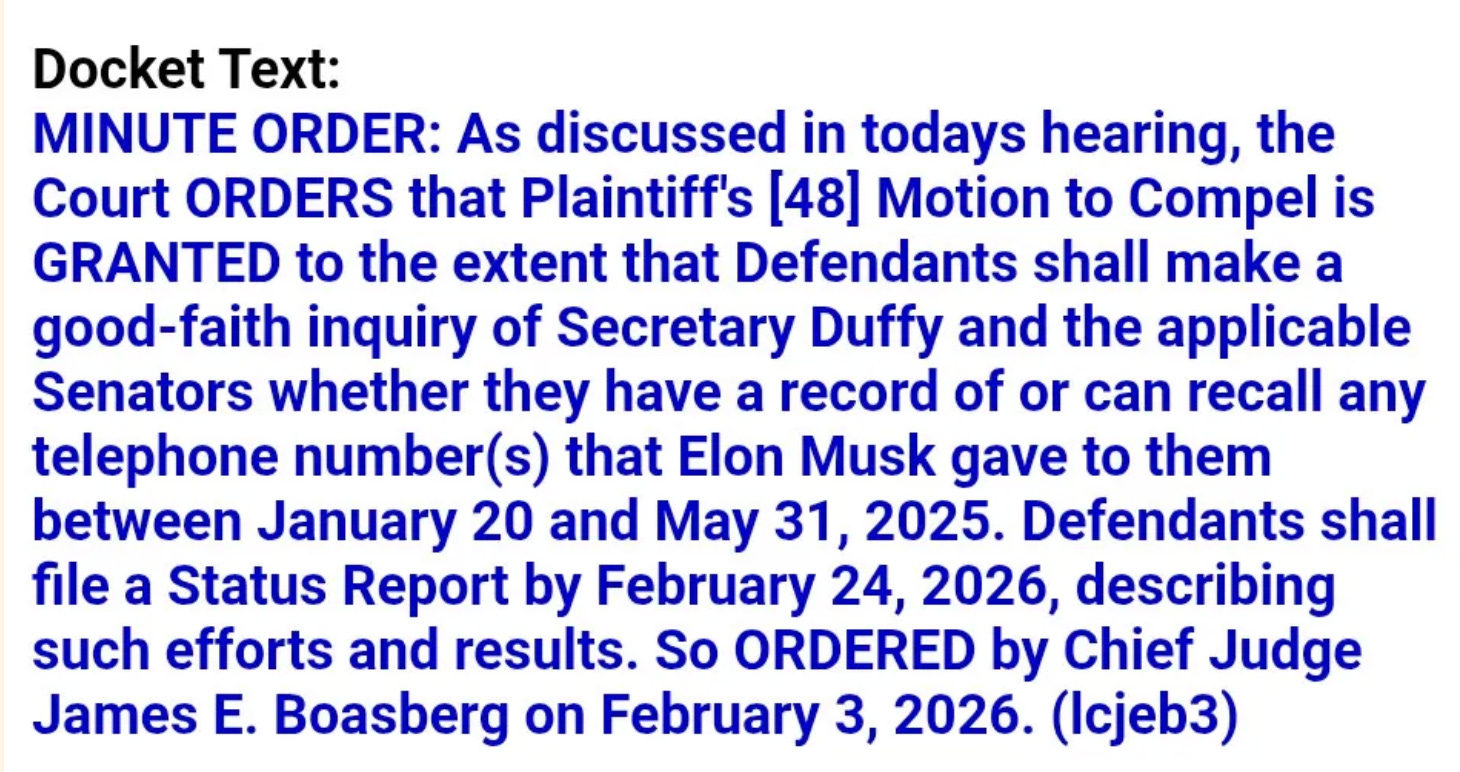
BOASBERG: Right. The good news is that you have a judge supervising it, and so you are not at the plaintiff’s beck and call responding to every ask they make. I will be determining if it’s reasonable. I hear you at this stage saying don’t send us off on a bunch of wild goose chases, but I think that step one is a reasonable request. So I will require you to engage. And I will issue an order that memorializes this.
If you’d like to support the work of Kel McClanahan and National Security Counselors with a tax-deductible donation, you can do so directly here.
If you have the means to support my work, please consider becoming a paid subscriber here on Substack.
~AG
Get em!!! Excellent work Allison and co!!!
Nice work.